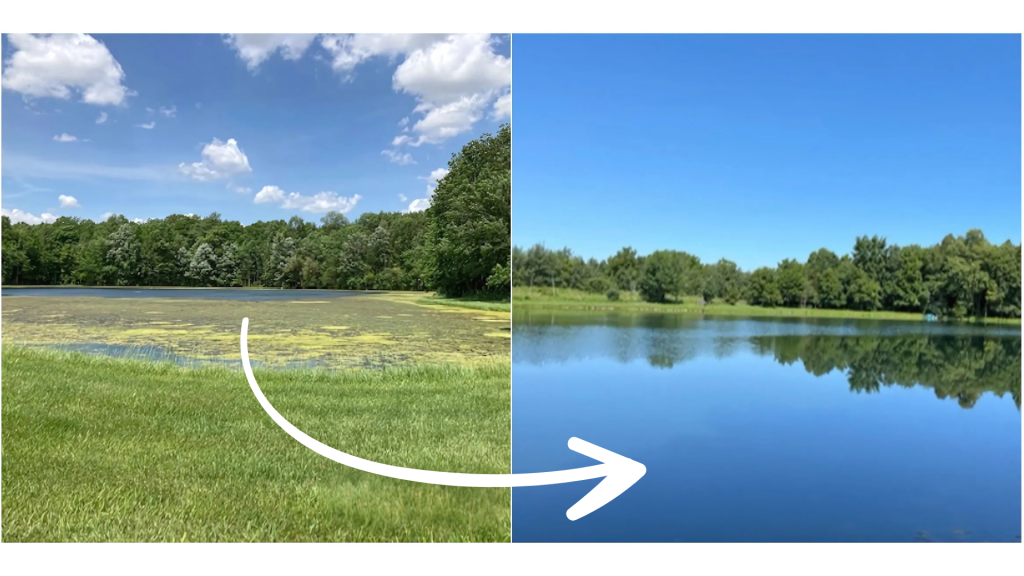
Algae growth can quickly turn a beautiful pond into a murky, green mess. While some algae are beneficial, excessive growth can lead to poor water quality, oxygen depletion, and even fish kills. If you’ve ever struggled with stubborn algae blooms, floating green mats, or foul-smelling pond scum, you’re not alone. The good news? With the right approach, you can take back control and restore the health of your pond. Read on to discover the types of algae, their impact, and the most effective treatment solutions to keep your water clean and thriving.
This blog explores the different types of algae commonly found in ponds, including planktonic, filamentous, and blue-green algae, and how they thrive on excess nutrients like decaying matter and runoff. It also highlights the negative impacts of uncontrolled algae growth, such as oxygen depletion, poor water quality, and unpleasant odors. Finally, it outlines effective algae control methods, from algaecide treatments to muck removal, pond dye, and beneficial bacteria, to help maintain a balanced and healthy pond ecosystem.

Algae is a simple organism that can be composed of one cell or many cells grouped together in a colony.
Algae feeds on nutrients in the water that are released from decaying matter such as fallen leaves, grass clippings, fish waste, uneaten fish food, dead bugs, dead aquatic vegetation, as well as phosphorous and nitrogen that washes into the pond from the surrounding land. It thrives when there is plenty of sunshine and warm water. When you have all or some of the above in your pond, you will have an algae problem.
There are over 17,000 forms of algae but only three basic types: Planktonic Algae, Filamentous Algae and erect forms such as Chara.
Planktonic algae are floating microscope plants that are normal and essential inhabitants of sunlit surface waters. Planktonic algae that color the water is often called a “bloom” or “algae bloom”. Blooms can be bright lime green, look like pea soup or even blood red. Planktonic algae blooms are considered desirable as the beginning of the pond food chain and for shading the pond bottom but too much can cause oxygen depletions and fish kills.
Blue-green algae, also known as Cyanobacteria, are a group of bacteria that many people refer to as “pond scum.” They are most often blue-green in color, but can also be blue, green, reddish-purple, or brown. Blue-green algae generally grow in lakes, ponds, and slow-moving streams. Most species are buoyant and will float to the surface, where they form layers on the surface that appear to be the consistency of paint. Concerns associated with blue-green algae include discolored water, reduced light penetration, taste and odor problems, dissolved oxygen depletions during die-off and toxin production.
Filamentous algae are single cells that form long visible chains, threads or filaments. Filamentous algae starts growing along the bottom in shallow water or attached to structures in the water, like rocks or other aquatic plants, but often floats to the surface where it forms large mats that are commonly referred to as pond scum or pond moss. There are many species of filamentous algae and it has no direct food value to wildlife.
Chara is often called muskgrass or skunkweed because of its foul, musty almost garlic-like odor. Chara is a gray-green branched multi-cellular algae that is often confused with submerged aquatic plants. However, Chara has no flower, will not extend above the water surface, and often has a “grainy” or “crunchy” texture. It thrives in clear, hard water and is difficult to kill once it becomes established.
The primary method of controlling excessive algae growth is to treat it with either a liquid or granular algaecides that contain copper sulfate.
Highland Pond Management specializes in comprehensive algae control solutions for a wide range of clients. Our experienced team utilizes the latest techniques and products to effectively manage and eliminate algae growth in your lake or pond.
Whatever your pond management needs, we have the expertise to keep your water features clean, clear, and healthy.
Contact us today to learn more about our algae control services and how we can maintain the beauty and functionality of your aquatic environment.
